
THANKSGIVING GAMES
Thanksgiving Table Games: Three Easy Games for Eight Guests
Dinner is finished, everyone is still at the table, and nobody wants a complicated explanation. That is a good moment for a small paper game. These three Thanksgiving table games give eight guests something to choose, draw and invent together. You can play one in a few minutes or use the full half-hour plan. There is no trivia to study, no need to leave your seat and no requirement to share a personal story.
Four to eight guests, including the host · Children and adults together
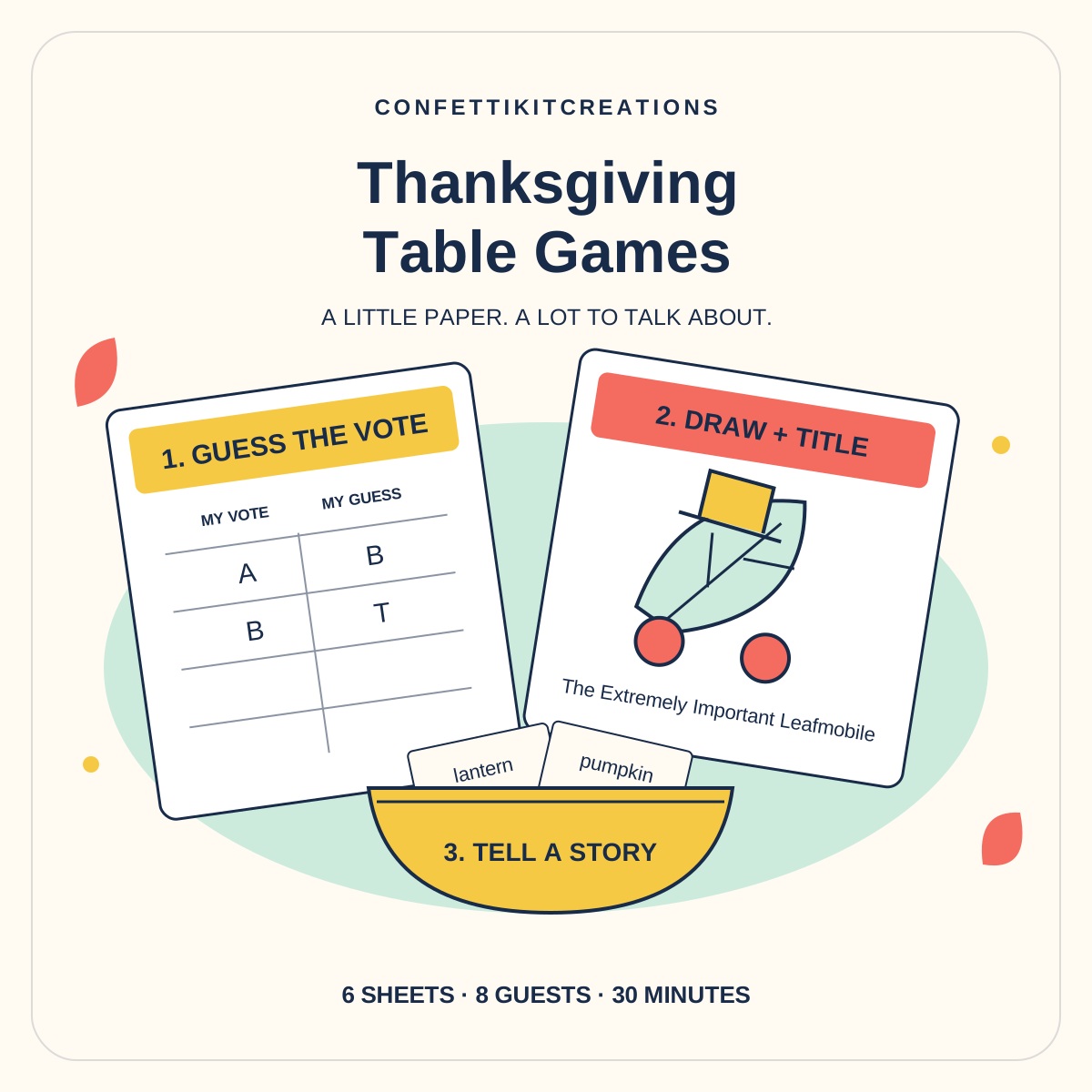
Prepare one small game tray
For eight players, including the host, gather six sheets of plain paper, eight pens, scissors, a small bowl and a clock. Colored pencils are optional. Use the scissors before guests arrive, then put the finished cards and pens together on a tray. The games use fictional choices and made-up stories, so the same set works for a family Thanksgiving or a Friendsgiving meal.
Cut two sheets into quarters for eight voting cards. Cut two more into quarters for eight drawing cards. Cut the fifth sheet into eight strips for story words. Keep the sixth sheet whole for the host’s prompts and timing. That gives you sixteen quarter-sheet cards, eight word slips and one host sheet. Nothing needs to be printed.
On each voting card, draw four rows numbered 1–4 and two columns labeled MY VOTE and MY GUESS. Leave the drawing cards blank. Put one story word on each strip using the list below. Keep everything away from the eating space until guests are ready, so the cards do not compete with plates and drinks.
- Explain that guests can play, team up with a neighbor or watch. Offer help with reading or writing without changing whose choice it is.
- Choose a host who can read four prompts and announce transitions. The host can also play all three games.
- For younger children, an adult can write the child’s spoken choice or prediction. Drawing skill and spelling are never scored.
- Choose one game if conversation is already flowing. The tray is an option, not an obligation to complete the whole schedule.
Game one: Guess the table’s vote
Hand each player one voting card and a pen. For each round, read the two imaginary choices below. Everyone privately writes A or B in MY VOTE, then predicts the group’s result in MY GUESS: A, B or T for a tie. A guest can prefer one option while predicting that the other will win. Write both answers before anyone reveals a vote.
Ask everyone to show their vote together, then count A and B. The choice with more votes is the result; equal totals mean T. Each player earns one point if their guess matches that result. Their own vote counts in the total, and there is no penalty for choosing the less popular option. Play four rounds for a maximum of four points, or skip scoring and enjoy the explanations.
A player may pass on a round. Count only the votes actually cast, so do not assume there are always eight. If nobody votes, skip that round without scoring. Let each person offer a short reason after the result, rather than campaigning before the votes are revealed. For a practice example, five A votes and three B votes mean that guests who predicted A each earn one point.
- Round 1 — A parade needs one imaginary float. A: a giant teacup on wheels. B: a treehouse pulled by friendly squirrels.
- Round 2 — Choose one magical hosting helper. A: a table that sets itself. B: dishes that wash themselves.
- Round 3 — Our make-believe autumn train needs a dining car. A: a tiny bakery. B: a floating picnic garden.
- Round 4 — Pick a vehicle for an imaginary dessert delivery. A: a cookie canoe. B: a balloon shaped like a slice of pie.
Game two: Draw an impossible centerpiece
Give each guest a blank drawing card. Announce one shared challenge: invent a centerpiece that includes a leaf, a wheel and something wearing a hat. It does not have to stand up, exist in real life or look like a conventional decoration. A leaf driving a hat-shaped car is as welcome as a carefully drawn autumn display.
Allow about two minutes to draw, with extra time if the group wants it. A guest can use words, simple shapes or a spoken description written down by a partner. The three requested elements are playful starting points, not a judging checklist. Nobody loses a turn because one element is missing or difficult to recognize.
Invite each person to pass their card one place to the left, around the table. The next person adds a title below the picture without changing the drawing. Allow about a minute for titles, then return the cards to their creators. Each creator can show the picture, read the title or pass. Keep the sharing brief enough that everyone gets a turn.
Try a title such as The Extremely Important Leafmobile or Professor Pumpkin’s Sunday Hat. Offer those only if someone wants help; they are examples, not answers to copy. Keep the cards as small souvenirs, or put them in the middle of the table for an informal gallery. There is no winning picture to choose.
Game three: The story-word bowl
Write these eight words on the eight prepared slips, one per slip: pumpkin, umbrella, train, pie, moon, mitten, ladder and lantern. Fold them once, mix them in the bowl and let each willing player draw one. If fewer than eight guests want to play, leave the unused slips in the bowl.
The host starts with this sentence: Someone rang the doorbell carrying a very small suitcase. Going around the table, each player adds one sentence that includes the word on their slip. The sentence should connect to something already said, but the story can become delightfully unlikely. The word is an invitation to contribute, not a puzzle with a correct answer.
For example, a player holding lantern might say: Inside the suitcase was a lantern that only lit up when someone laughed. The next player could use train by sending the suitcase on a journey. Offer thinking time or let a guest ask their neighbor for an idea. If someone passes, the next player simply continues; the host can weave in any unused word at the end.
After one trip around the table, ask for one final sentence to close the story. If guests want another round, return the slips to the bowl and draw again. You can start a fresh story or add a new chapter. There is no score, no memory test and no need to repeat the whole story from the beginning.
Fit the games into thirty minutes
Bring out the tray after people have finished eating and are ready for a change of pace. The following schedule includes explanations and sharing, so it works as a complete activity window. Treat it as a guide: if the drawing round is especially enjoyable, let it continue and drop the second story round.
Keep the host sheet beside you with the four voting prompts and eight story words. Read each rule in the moment it is needed. Guests do not need to absorb three different games before the first one starts. When it is time to stop, finish the current turn and offer a clear ending instead of beginning another round by accident.
- 0–4 minutes: invite people to join, hand out voting cards and demonstrate one practice result.
- 4–12 minutes: play the four voting rounds, including short explanations after each result.
- 12–19 minutes: draw the impossible centerpiece, exchange cards for titles and share.
- 19–27 minutes: make one or two short stories with the word slips.
- 27–30 minutes: let guests keep their pictures, collect pens and return to conversation.
Adapt the table without adding more rules
For four players, make four voting cards and four drawing cards from two sheets. A third sheet supplies the eight word slips, and a fourth becomes the host sheet. Use the same four voting prompts and let each person draw one word per story. A smaller table can spend more time explaining its wonderfully improbable choices.
For twelve guests, two groups of six usually make the story easier to follow. Prepare twelve voting cards from three sheets, twelve drawing cards from three more, twelve word slips from a seventh sheet and a host sheet from an eighth. Repeat four of the suggested words to make twelve slips. Divide the supplies between the tables; each group counts its own votes and builds its own story.
Keep personal questions out of the game unless the group specifically wants them. An imaginary train or centerpiece lets relatives, friends and new guests contribute without explaining relationships, work or private plans. Guests can be funny, quiet, literal or wonderfully imaginative. A comfortable ending is everyone having had a chance to join, with no one required to perform.
Questions, answered.
Do we need a printer or a purchased game pack?
No. All prompts and rules are included here, and the eight-player version uses six sheets of ordinary paper. The illustrated activity cards are homemade examples, not a paid Thanksgiving product.
Can children play alongside adults?
Yes. Read prompts aloud and let children dictate choices, draw simple shapes or team up with a willing adult. Choose the amount of help each child wants. Only the optional prediction guesses earn points; artwork and storytelling are unscored.
What if we have time for only one Thanksgiving table game?
Choose the voting game for a short seated activity, the centerpiece drawing for a keepsake or the story bowl for conversation. Explain only that game, play a single round if needed and stop while guests still want to chat.