
CHRISTMAS GIFT EXCHANGE
White Elephant Gift Exchange Rules: A Clear Plan for Twelve Guests
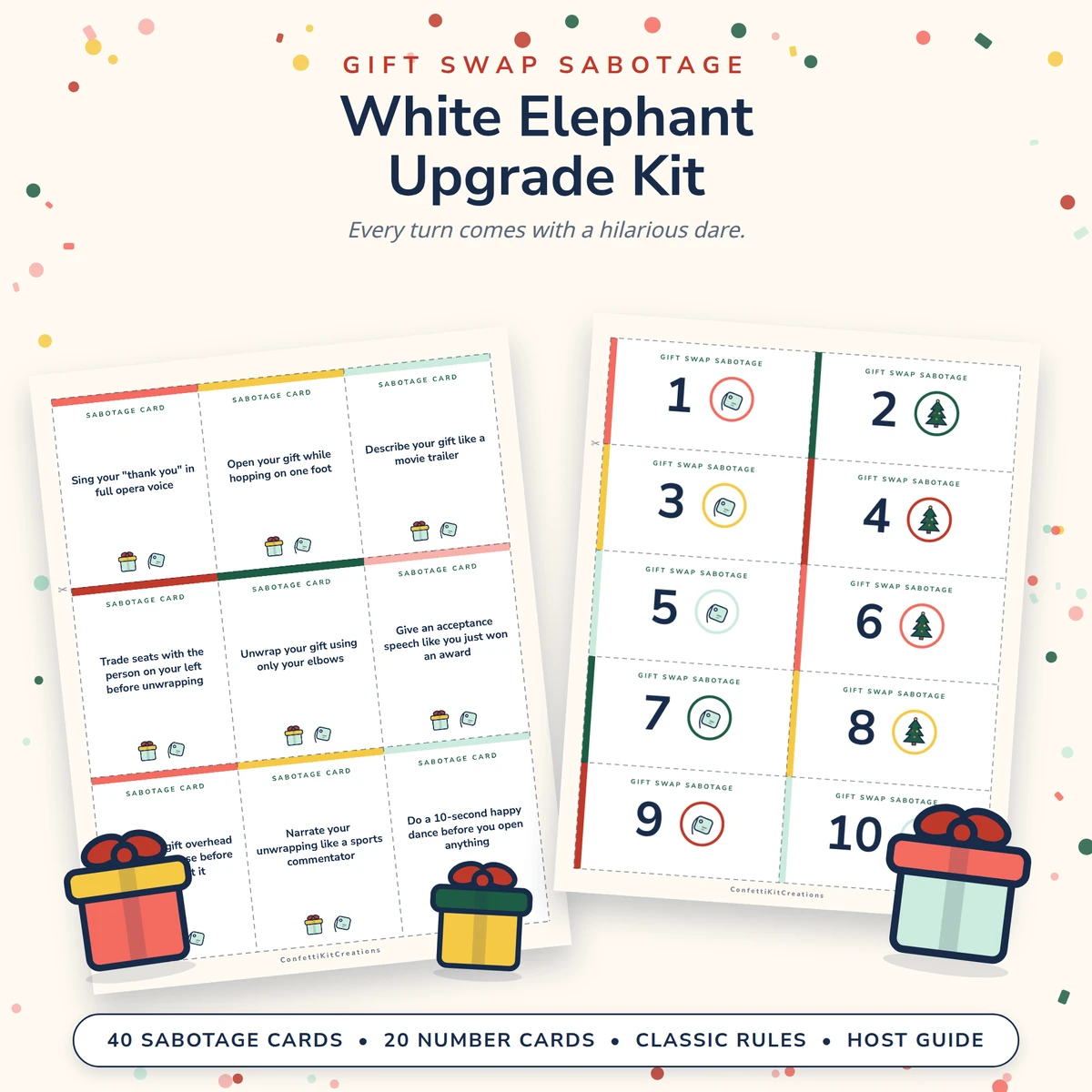
The awkward part of a white elephant exchange is usually the rule nobody explained until somebody wanted the good gift. Decide the spending limit, stealing rules and ending before guests arrive. This guide gives you one complete house-rule version for twelve players, including a short example you can read aloud. Use it as written or choose a different version together before the first present opens. If you want a twist on the classic exchange, our Gift Swap Sabotage printable includes 40 challenge cards and numbers 1–20.
Twelve gift-exchange players · One host · About 50 minutes
Put the gift agreement in the invitation
Ask each participating player to bring one wrapped gift within an agreed spending limit. Choose that limit with your group; it is a cap, not a target everyone must reach. Say whether secondhand items, handmade gifts, food or joke gifts are welcome. A useful invitation might ask for something another guest could actually enjoy, with no gifts aimed at embarrassing a particular person.
Confirm the number of people playing separately from the party headcount. A guest who only wants to watch does not need to bring a gift. If a couple brings one gift, they share one player number and finish with one gift. Avoid changing those expectations at the door.
White elephant exchanges have many variations. The rules below are this guide's house version, not a claim that every exchange or printable kit uses the same system. Send a short summary with the invitation and keep the full version where the host can see it.
- One wrapped gift per participating player, with clear agreement on the spending limit.
- Any gift theme and exclusions stated in advance.
- A planned game start and a separate invitation to watch without exchanging.
- A note that the host will explain the complete rules before anyone draws a number.
Set up twelve places and a simple tracking sheet
Put the wrapped gifts together on one table. Arrange seats so players can see the opened gifts without repeatedly standing up. The host can carry a gift for someone who prefers to stay seated. Keep wrapping cleanup close to the gift table rather than building a pile around people's feet.
Make twelve number slips from three sheets cut into quarters. Use a fourth sheet as the host record, with twelve rows labeled Gift 1 through Gift 12 and two empty boxes beside each. Keep a fifth sheet for the rules. Identify each present by the order it is opened and write a short description on its row so everyone knows which gift a rule applies to.
- Twelve wrapped gifts and twelve player-number slips, numbered 1–12.
- Five sheets in total for homemade numbers, a tracking sheet and the rules.
- One bowl for drawing numbers, two pens and a container for wrapping.
- A visible place for opened gifts, including ones that become frozen.
- An optional spare gift agreed with the host in advance, rather than expecting an unplanned purchase.
Read these rules before the first turn
Everyone draws one number. A numbered turn is complete only when the person left without a gift opens a wrapped one. That definition matters: a steal can pass the choice to another person, but it does not immediately advance the main turn order.
Use both limits below. A gift freezes after its second steal across the entire game, and a numbered turn allows at most three steals before the next displaced player must open a wrapped gift. The host marks the gift's boxes after each steal and counts the turn's steals aloud. Opening a wrapped gift is not a steal.
- Player 1 selects and opens one wrapped gift, then shows it to the group.
- At the start of each later numbered turn, that player may open a wrapped gift or steal an eligible opened gift.
- A person whose gift is stolen immediately chooses a wrapped gift or steals another eligible gift.
- You cannot immediately steal back the gift just taken from you, and no gift can be stolen twice within the same numbered turn.
- After a gift's second steal across the game, it freezes with its current holder and cannot be stolen again.
- After the third steal within a numbered turn, the displaced player must open a wrapped gift. That ends the turn.
- The next unused player number then begins its turn. When Player 12's turn finishes, the exchange ends.
- This version has no final extra steal for Player 1. Everyone keeps the gift they hold; any later trade must be freely agreed by both people.
Walk through one stealing chain
Imagine Player 4 begins by taking the mug that Player 1 opened earlier. The host marks the mug's first steal and announces one steal in this turn. Player 1 now needs a gift. They cannot immediately take the mug back, so they choose the puzzle held by Player 2. That is the second steal in Player 4's turn.
Player 2 then takes the candle held by Player 3. The host announces the third steal. Player 3 must now open a wrapped gift, which ends Player 4's turn. Everyone has one gift, one more wrapped present has been opened and Player 5 starts next. The mug, puzzle and candle cannot circulate again within that completed turn.
Later, if the mug is stolen a second time in a different numbered turn, it freezes with that new holder. The limit belongs to the gift, not to the person. If there is uncertainty, pause before moving anything and use the host's record to resolve it.
Allow time for the explanation and the wrapping
For twelve players, reserve about 50 minutes as a planning allowance, not a guaranteed running time. Longer stories and elaborate wrapping can add time. Keep choices moving with a friendly reminder rather than surprising someone with a new penalty. If you need a strict finish, choose a simpler no-steal exchange before play begins.
With the three-steal cap, the eleven numbered turns after Player 1 can contain at most 33 steals in total; the two-steals-per-gift rule may reduce that further. The cap prevents an endless chain, but unwrapping and conversation still take time.
- 0–10 minutes: collect gifts, draw numbers and demonstrate the worked example.
- 10–40 minutes: play the twelve numbered turns, with the host tracking each steal.
- 40–50 minutes: finish the final turn, thank everyone and gather the wrapping.
- For a no-steal version, each player opens one gift in number order; allow optional mutually agreed trades after everyone has opened.
Add a printable twist only after choosing one rule set
Our optional Gift Swap Sabotage download contains 40 sabotage cards, number cards 1–20, a Classic Gift Swap Rules sheet and a host guide. The four PDFs total nine pages. It supplies printable game materials; guests still bring the gifts, and the host supplies paper and assembly materials.
If you choose that version, read and use its included rules and host guide. This article's worked example does not describe the sabotage cards, and its house limits should not silently override a card instruction. Choose one complete version before the gathering and explain it consistently.
Prepare the printables ahead of time, checking a test page before printing the full set. Put unused number cards away so thirteen through twenty cannot accidentally enter a twelve-player draw. At the end, save the reusable numbers and rules together for the next exchange.
Questions, answered.
How many times can a gift be stolen?
In this guide's house version, twice across the whole game. It freezes after the second steal. Separately, each numbered turn permits at most three steals, and a gift cannot be stolen twice in that same turn.
Does the first player get another turn at the end?
Not in this version. Some groups use a final-choice rule, but it changes the ending and needs its own explanation. Here, the game finishes when the last numbered turn ends, followed only by mutually agreed voluntary trades.
What if a guest arrives without a gift?
Let them watch or share a player number with a consenting partner. If the host prepared a spare, offer it privately before the draw. Do not turn an unexpected situation into a public explanation about money.