
TWEEN BIRTHDAY IDEAS
Tween Birthday Party at Home: A Creative Plan for Ages 10–12
For a tween birthday at home, we suggest a creative studio party: make an accordion mini-book, tackle a paper bridge challenge and share a silly caption gallery. This three-hour plan serves eight guests ages 10–12, with ordinary supplies and room for guests to choose how they join in. Ask the birthday child to help pick the style, then keep the day simple enough to enjoy together.
Parents planning an at-home birthday for eight guests ages 10–12
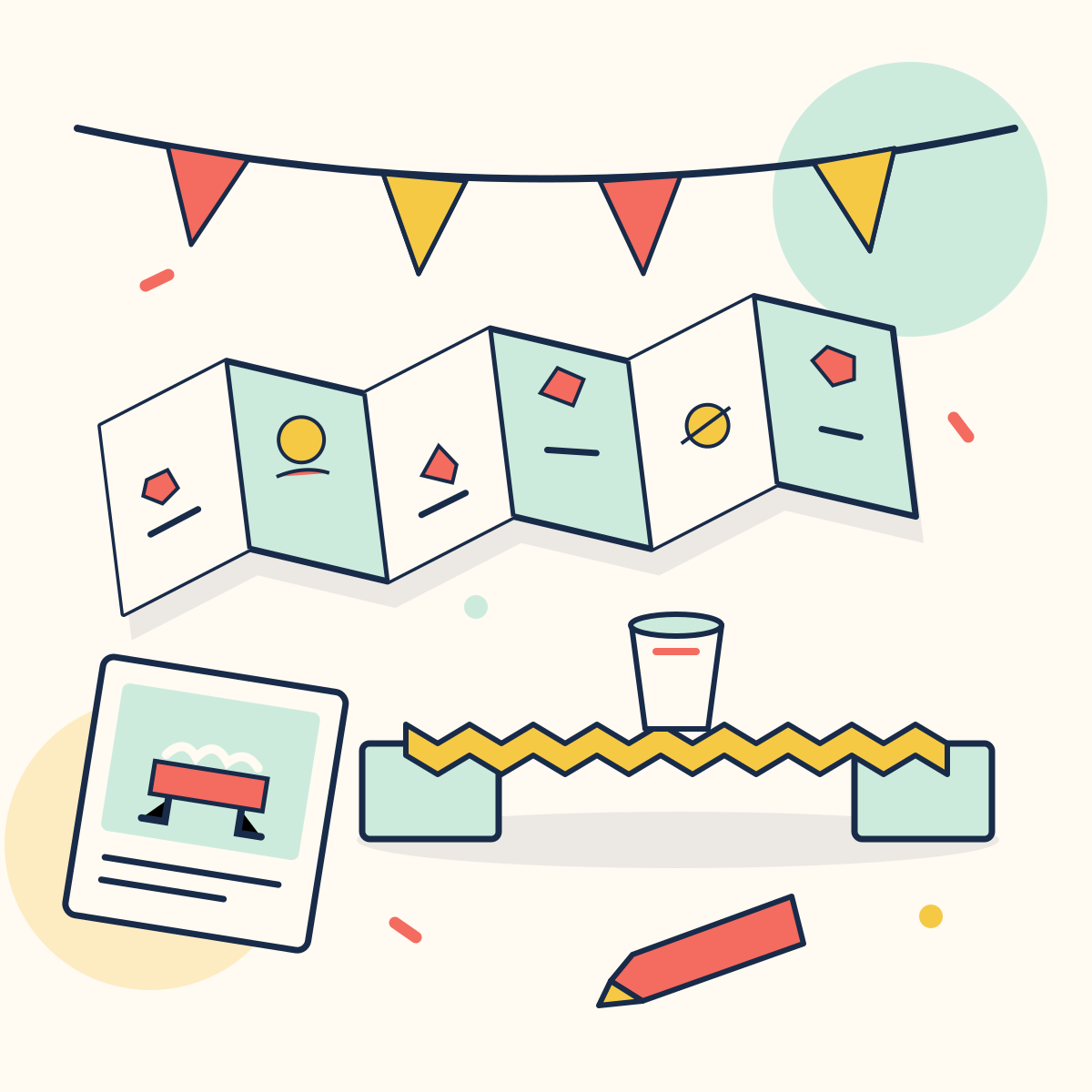
Plan with the birthday child and set up three zones
Offer two or three workable choices rather than a blank planning sheet: space explorers, favorite colors or a tiny art festival. Let the birthday child choose one theme, a shared activity and a food option from choices you can provide. Explain the guest limit and finish time before invitations go out. A studio theme works with any of these choices; nobody has to enjoy the same kind of art.
PBS KIDS suggests involving children in manageable party decisions and building around activities they enjoy. That informs our planning approach; the projects and three-hour schedule here are our own suggestions, not a rule for every tween.
Use a main worktable with eight reachable seats, a separate clear surface for the bridge test and a quieter seat with spare drawing paper. The same main seats serve both paper activities, so you do not need three tables. Keep drinks away from finished artwork. Agree on passing, asking for help and leaving projects unfinished; all are ordinary options.
- Confirm attendance, pickup time and food preferences or requirements with caregivers before buying supplies.
- Ask before taking or sharing photos. The party works without phones, accounts or posting anything online.
- For a younger sibling, prepare a simpler drawing sheet and offer a helper. Keep the older guests’ optional challenges available.
Gather supplies for eight guests
Count the birthday child among the eight participants. Put each activity’s materials in its own tray and leave only the current tray on the worktable. These quantities include a few restarts; check what you already have before shopping.
- Paper: 40 plain Letter-size sheets—8 for arrival drawings, 8 for two strips per guest’s mini-book, 16 for two bridge attempts per pair, 4 for eight caption cards, and 4 spares.
- Drawing and measuring: 8 pencils, 2 shared sets of colored pencils or washable markers, 4 rulers and 1 adult marker.
- Building: 1 roll of masking tape, 2 equal-height sturdy supports such as closed boxes, and 1 empty lightweight paper cup. Keep the supports on the table throughout the test.
- Packing and organization: 8 envelopes, 3 supply trays, adult-use scissors and a scrap-paper container.
- Refreshments: 8 plates, 8 cups, 16 napkins, water and the food you agreed on. Add separate servings for attending adults as needed.
Project 1: make an accordion mini-book
Before the party, place each of the eight mini-book sheets landscape and cut it horizontally into two long strips. Each strip is 11 inches long and 4.25 inches tall. On one sample, mark five evenly spaced fold positions along the long edge, making six panels of roughly equal width. Fold back and forth along those marks to create an accordion. Mark the other strips beforehand if your guests would prefer to skip measuring.
Give each guest two strips: one for a book and one for a restart or second book. They fold six panels and choose a project: a tiny museum of invented objects, a six-scene comic or a pocket guide to an imaginary planet. The first panel can be a cover, leaving five panels for the collection or story. Invite drawings, symbols, captions or a mixture; artistic skill is not the aim.
A satisfying finish is simply one idea on each panel. Guests who want more can add a detail repeated across the book or decorate the reverse. Everyone keeps their own book, and showing it to the group is optional. Place finished books in the envelopes before serving food.
- Simpler option: provide a folded strip and let the guest choose three favorite panels to decorate.
- Extra challenge: tell a story without words, or make the last panel explain a mystery introduced on the cover.
- A guest can dictate captions, choose colors for a helper or design a single-page poster instead.
Project 2: build a bridge together
Make four pairs and give each pair two sheets of paper plus a 12-inch length of masking tape for its first bridge. Set two equal-height supports eight inches apart on the test table. Show the empty cup before anyone designs. The shared challenge is to span the gap using only the paper and tape, then hold that same empty cup for five seconds.
Pairs may fold, roll or layer their paper. The bridge must rest on both supports, with no help from hands during the test. Measure the gap with a ruler before each turn, place the cup gently at the middle and count five seconds together. An adult manages the test surface. Keep it tabletop: no standing on paper structures and no heavy loads.
After every pair has tested, invite each to share one observation. Give each pair two fresh sheets and another 12-inch tape length for an improved attempt. A pair whose first bridge held can try a different fold and compare; a pair whose bridge sagged can borrow another team’s idea. Finish by identifying something the group learned, with no fastest-builder prize.
- Offer two practice shapes if someone needs a start: a flat sheet and a folded accordion. Test and discuss both before choosing.
- Guests can take design, folding, measuring or observation roles and swap roles for the second attempt.
- If the gap is too difficult, shorten it for the whole group and say so before the next round. Use the same cup and gap when comparing attempts.
Project 3: create a caption gallery
Cut four sheets in half beforehand to make eight caption cards. Draw a large frame on each, with space below for a sentence. Each guest invents a make-believe scene: a cake wearing rain boots, a moon opening a bakery, a pencil taking a holiday or their own idea. Keep people’s appearances and real-life embarrassments out of the joke.
Pass each drawing one seat clockwise. The next guest writes a kind, silly caption, then returns it to its artist. A guest may keep their own drawing and caption it themselves instead. Place willing guests’ work on the table for a seated gallery; read aloud only with the artist’s permission. Ask everyone to notice an inventive detail rather than vote for a winner.
- Writing is optional: guests can dictate a caption to a helper or add a speech bubble made of pictures.
- For a second round, use spare sheets and change the prompt to something that might happen on an imaginary birthday planet.
- Put each finished card in its owner’s envelope. The artwork doubles as a take-home keepsake.
Follow a flexible three-hour schedule
These are planning blocks, not performance targets. Each includes explanation and tidying. Keep food and pickup on time; shorten a second attempt or leave a project unfinished if the group needs more breathing room.
- 0–15 minutes: arrivals, water and optional doodles on the eight arrival sheets.
- 15–25 minutes: welcome, show examples and let guests choose their mini-book idea.
- 25–60 minutes: fold, draw and pack mini-books.
- 60–95 minutes: two paper bridge attempts, with shared observations and a brief water break.
- 95–125 minutes: collect tools and serve the planned food and birthday cake.
- 125–150 minutes: draw and caption gallery cards.
- 150–170 minutes: optional gallery, finish a favorite project or choose quiet drawing.
- 170–180 minutes: pack artwork, return supplies and greet caregivers at pickup.
Prepare once, then keep cleanup small
If your child chooses a space theme, our Space Birthday Party Kit can supply matching invitations and decorations. It is a non-personalized instant download with 6 PDFs / 15 pages, available through Etsy or Payhip; no physical items are shipped. Check the preview and included pieces before choosing it. The three activities in this guide are separate handmade projects, and we do not assume the kit’s printable puzzles suit every tween.
- Several days before: let your child make the agreed choices, confirm guests and refreshments, and gather existing supplies.
- The day before: cut the book strips and caption cards, fold a sample book, test the bridge setup and label the activity trays.
- Before arrivals: place eight seats, clear the test table, prepare envelopes and keep later trays out of the way.
- Between projects: guests return shared tools and adults move the next tray into place. Keep scraps in one container.
- At pickup: check envelopes for each guest’s work, collect pencils and rulers, wipe the surfaces and save clean spare paper for another day.
Questions, answered.
Will this feel too young for a 12-year-old?
Ask the birthday child before choosing the plan. Guests can invent a museum, draw a wordless comic and compare bridge designs rather than follow a fixed cartoon theme. More detail is optional; change the style if those projects do not interest them.
Can we shorten the party to two hours?
Yes. Allow 15 minutes for arrivals, 30 for mini-books, 25 for one bridge attempt, 25 for food and cake, 15 for the caption gallery and 10 for packing and pickup. Cut the extra building round and extended finishing time.
How do we adapt this for four or six guests?
Use two or three bridge pairs. Allow two full sheets per guest for arrival drawing and two mini-book strips, plus one half-sheet caption card. Add two building sheets per guest across both attempts and a few full-sheet spares.
Do we need to buy a printable kit to use this plan?
No. All three projects use ordinary paper and drawing supplies. A themed printable kit is optional for invitations and decorations; the free guide’s mini-books, bridge instructions and caption game are separate DIY suggestions.