
THANKSGIVING CLASSROOM
How to Plan a Thanksgiving Class Party in 45 Minutes
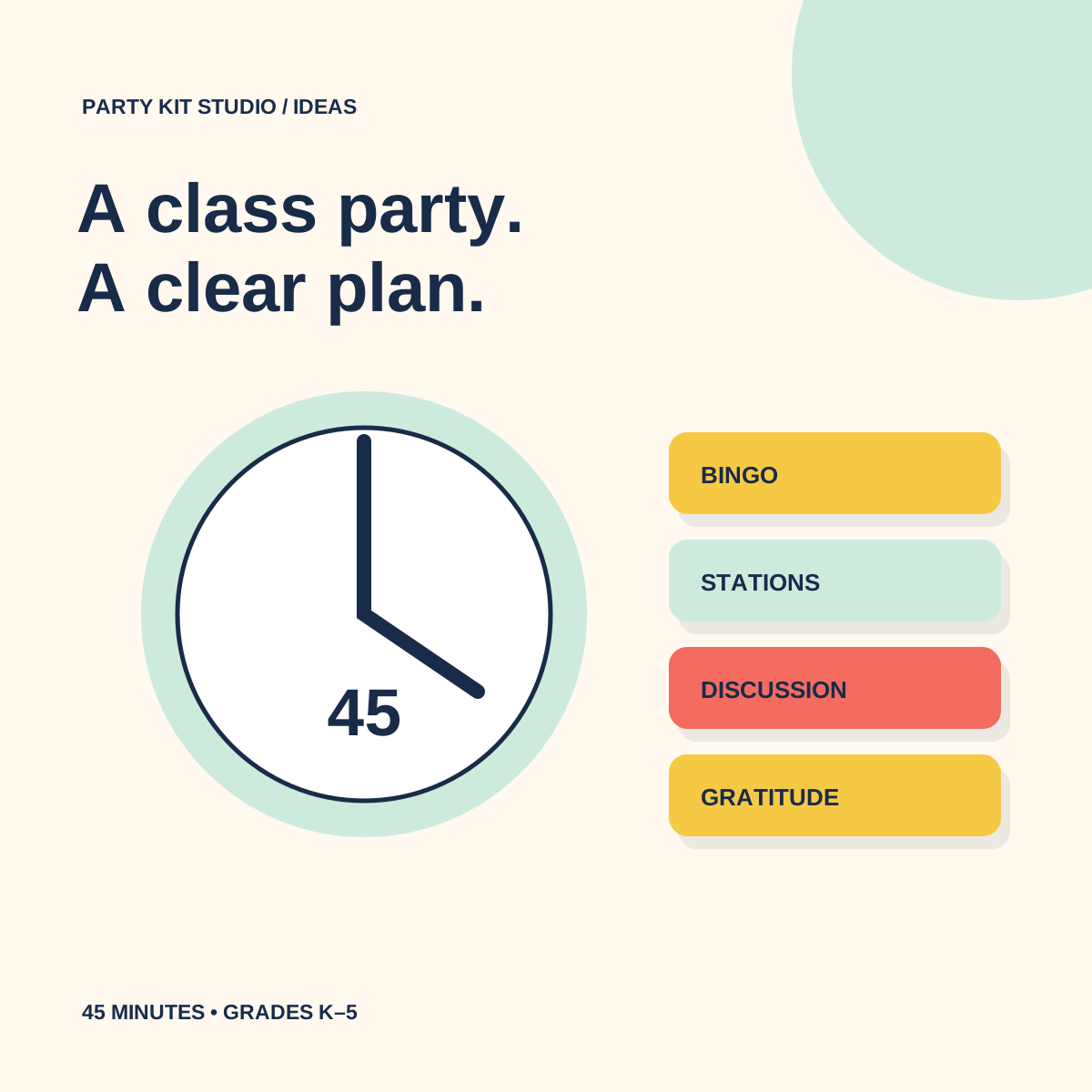
Forty-five minutes sounds generous until a class is finding pencils, asking which page comes next and wondering whether bingo has started. We like a party plan with a clear opening, a predictable middle and a calm finish. These Thanksgiving class party ideas fit one lesson-length celebration for up to thirty students. You can run them with your usual classroom routines, move materials instead of children when space is tight, and leave everyone with something finished rather than a folder of half-started tasks.
Teachers and classroom helpers · Grades K–5
Before the party: prepare five pages per student
Our Classroom Edition printable pack brings together thirty unique picture bingo cards, coloring, maze and I Spy activities, discussion cards and a thankful-writing page. Use its teacher guide and print checklist to choose the pages for this schedule. Print the thirty different bingo cards once each; do not print thirty copies of one card. Put the calling sheet and discussion prompts in a separate teacher folder.
For a class of thirty using one coloring page, one maze, one I Spy page and one gratitude page per child, prepare 150 student sheets in total, including bingo. Add only the teacher pages you need. Keep student work single-sided if children will take it home separately. Set out pencils, ordinary crayons and a small scrap-paper practice card. Use materials already familiar to your class, with a seated option for every activity.
Before choosing a Thanksgiving theme, follow your school’s approach and offer an autumn or appreciation framing when appropriate. These games are a celebration plan, not a lesson about the holiday’s history.
Minutes 0–10: open with whole-class picture bingo
Greet students with their bingo card already on their desk. Explain the winning pattern before calling: one completed row, for example, using the layout on the actual card. Show how to mark one picture and how to signal a possible win with a raised hand. A practice example should demonstrate the action without becoming a surprise first call.
Call the picture name, display the calling card and pause long enough for students to scan. Keep called pictures visible. When someone signals, ask them to name or point to their marked pictures and check against that display. Allow shared wins when the same call completes several cards. Stop at the planned time even if there is no winner; the next activity is ready.
- 0–2 minutes: settle, distribute any missing materials and explain the goal.
- 2–4 minutes: demonstrate marking and the quiet signal for a possible win.
- 4–9 minutes: call pictures at a steady pace and check any wins.
- 9–10 minutes: finish the current call, collect reusable markers and explain the station order.
Minutes 10–29: rotate coloring, maze and I Spy
Make three activity zones, each with room for ten students; two nearby groups of five can share a zone. Color-code the zones with words as well as colors so the order is clear. Give each child an activity folder to carry finished work. If movement would be awkward, keep students in their usual seats and distribute the next page at each change instead. The station sequence still works.
At coloring, invite students to choose three colors or add a patterned border. At the maze, suggest tracing a possible route lightly before committing. At I Spy, ask students to choose a search method, such as working across the page in rows. These are optional strategies, not extra requirements that turn the party into a test. A finished student can add detail, check a route or quietly help a willing partner.
Keep instructions on a single teacher note. You do not need to reteach each task at every rotation. Explain where completed work goes and what happens to shared supplies. Give a short warning before each change, then let unfinished pages travel with their owners rather than treating speed as the goal.
- 10–12 minutes: demonstrate the three tasks and show the rotation order.
- 12–17 minutes: first station.
- 17–18 minutes: change places or pass out the next activity.
- 18–23 minutes: second station.
- 23–24 minutes: second transition.
- 24–29 minutes: third station, then place finished pages in folders.
Minutes 29–35: bring everyone together for Would You Rather
Read two or three discussion cards aloud. For each one, let students show their preference with one or two fingers at chest height, point to a choice or pass. A seated response keeps the discussion accessible and avoids another room transition. Give thinking time before inviting explanations so the quickest speaker does not set everyone else’s answer.
Ask for a reason using a sentence frame such as, “I would choose this because…” Invite two different viewpoints, then move on. There is no correct preference to announce. For younger students, repeat the choices and accept a gesture. Older students can explain what might change their minds. End after the planned prompts, even if more cards remain; keeping a few for another day is useful.
Minutes 35–43: close with gratitude writing or drawing
Offer one concrete invitation: think of something that made an ordinary school day a little easier. It could be a helpful object, a place, an action or a person without naming them. A sharpened pencil, a quiet seat or someone holding a door are all workable answers. Students may choose a different topic or keep their response private.
Give children several ways to respond on the thankful-writing page: a drawing, a label, a dictated sentence or a short paragraph. We suggest one minute to choose an idea, five minutes to create and two minutes for optional partner sharing. Do not require a positive account of home life or a public thank-you. The writing belongs to the student, and a small, specific answer is enough.
Minutes 43–45: finish with the room ready
Use the final two minutes for a familiar cleanup routine: papers into folders, pencils into their usual containers and tables checked by the students sitting there. Name the next part of the school day so the party has a clear ending. If the schedule slips, shorten discussion before cutting the cleanup window.
For another class, keep the same structure and change only the pacing or level of help. Review the Classroom Edition printable pack when you want the activities and teacher materials together. Print only the pages you will use, leave the rest for another session, and write one quick note afterward about the timing you would change next time.
Questions, answered.
Can we run this party without parent volunteers?
Yes. Keep the activity directions simple, use your usual seating and change pages instead of moving groups. Prepare supplies before students arrive so you can lead the whole class.
What should we shorten if the class starts late?
Use fewer bingo calls or two discussion prompts. Keep a brief gratitude response and the final cleanup window, rather than rushing every part of the plan.