
INDOOR BIRTHDAY IDEAS
Indoor Birthday Games for a Small Living Room
For a small living room, choose games that happen at each guest's seat: action guessing, picture directing and a silly shared story. We planned this 90-minute ConfettiKitCreations party for six children ages 5–12. All three games use ordinary paper supplies, and you can change the challenge without changing the room.
Parents hosting a birthday in a small living room for children ages 5–12
Make one seated play area and gather supplies
Arrange six seats so everyone can see the adult leading games. Use the sofa and chairs you already have; keep a clear route to the door and bathroom. Give each guest a clipboard or firm writing surface. Set the guest count by the seats you can fit comfortably.
Keep games in three labeled folders beside the adult. Use the same seats throughout, collecting paper before refreshments. Ask caregivers about food needs and helpful adaptations beforehand. A guest can watch, pass or take a drawing break at their seat.
- Paper for six guests: 30 plain sheets—6 for arrival drawings, 6 for drawing practice, 12 for paired drawing rounds, 1 adult sample, 2 for prompt cards and 3 spares.
- Shared supplies: 6 clipboards or firm lap boards, 6 pencils, 12 crayons, 1 adult marker, adult-use scissors, 3 folders and 1 bowl for cards.
- Refreshments and packing: 6 cups, 6 plates, 12 napkins, water, chosen food and 6 envelopes for finished drawings. Keep drinks on a stable surface away from lap boards.
- An adult cuts each of the two card sheets into eight rectangles beforehand. Put cutting tools away before guests arrive.
Game 1: guess the birthday action
Make eight action cards: wrap a present; stir pretend cake batter; put on a party hat; open a birthday card; unroll a banner; play an imaginary trumpet; wave like a robot; blow out imaginary candles.
Going around the seats, the adult shows or quietly reads one card to each player. The player acts using hands, face and shoulders while staying seated. Invite guesses one guest at a time. After three suggestions, reveal the action together. Return the card to the pile before the next turn. Play one turn each, then offer another round if wanted.
- Ages 5–7: quietly offer two actions to choose between and let the adult join the mime.
- Ages 8–9: try one action independently, adding an expression to help the group.
- Ages 10–12: combine two cards in one turn; the group tries to identify both actions.
- Any guest may direct the adult's movements, choose a card for the adult to perform or join as a guesser. Nobody is eliminated.
Game 2: direct a mystery picture
Draw your sample beforehand: a large circle in the middle, a small triangle above it and a wavy line below it. Keep it hidden. Give everyone a practice sheet and describe those three parts one at a time. Children draw what they hear and may ask questions. Reveal the sample and discuss which directions helped.
Next, make three pairs. Give each guest two fresh sheets: one for a secret picture made from three simple shapes, one for copying their partner's picture. Partners take turns describing their secret picture while the other draws. Keep originals hidden until both descriptions are finished, then compare. Celebrate a clear instruction and improve one vague clue together.
- Ages 5–7: name shapes directly and give one instruction at a time. Showing the original is an available alternative.
- Ages 8–9: describe three shapes and their positions, such as beside or below.
- Ages 10–12: describe shapes without naming them, such as a shape with three straight sides. Questions remain welcome.
- A guest can dictate, point to an example or direct a helper holding the pencil. Keep pairs close enough to hear each other; shorten to the adult-led round if overlapping voices become distracting.
Game 3: fix the impossible party
Write eight story surprises on your second card sheet: the cake has wheels; a hat grows flowers; the invitation talks; a tiny dragon arrives; a balloon wants a chair; the present is invisible; the music falls asleep; the table floats on a cloud.
Start with: Our party is about to begin, when something surprising happens. Each guest chooses a card, has it read aloud and invents a make-believe fix. For example, a wheeled cake could park on a giant plate. Continue around the seats until everyone has a turn. The adult briefly retells the group's solutions, then invites everyone to choose an ending. All fixes stay inside the imaginary story.
- Ages 5–7: offer two possible fixes to choose from, or accept a gesture the adult describes.
- Ages 8–9: add a sentence explaining how the fix works.
- Ages 10–12: connect a fix to an earlier idea, such as asking the tiny dragon to guard the wheeled cake.
- Passing is welcome. A guest can choose between two endings or draw their favorite scene instead of speaking.
Use this 90-minute timeline
These blocks include explanations and collecting supplies. If a game runs long, skip its extra round and keep cake and pickup on time.
- 0–10 minutes: arrivals, water and optional drawings on the six arrival sheets.
- 10–15 minutes: welcome, explain passing and demonstrate one seated action.
- 15–30 minutes: birthday action guessing.
- 30–45 minutes: adult-led picture practice and paired drawing rounds.
- 45–60 minutes: collect boards and pencils; serve refreshments and birthday cake, with a bathroom break.
- 60–75 minutes: impossible-party story.
- 75–90 minutes: optional drawing sharing, pack artwork, return supplies and welcome caregivers.
Prepare the cards, then pack away quickly
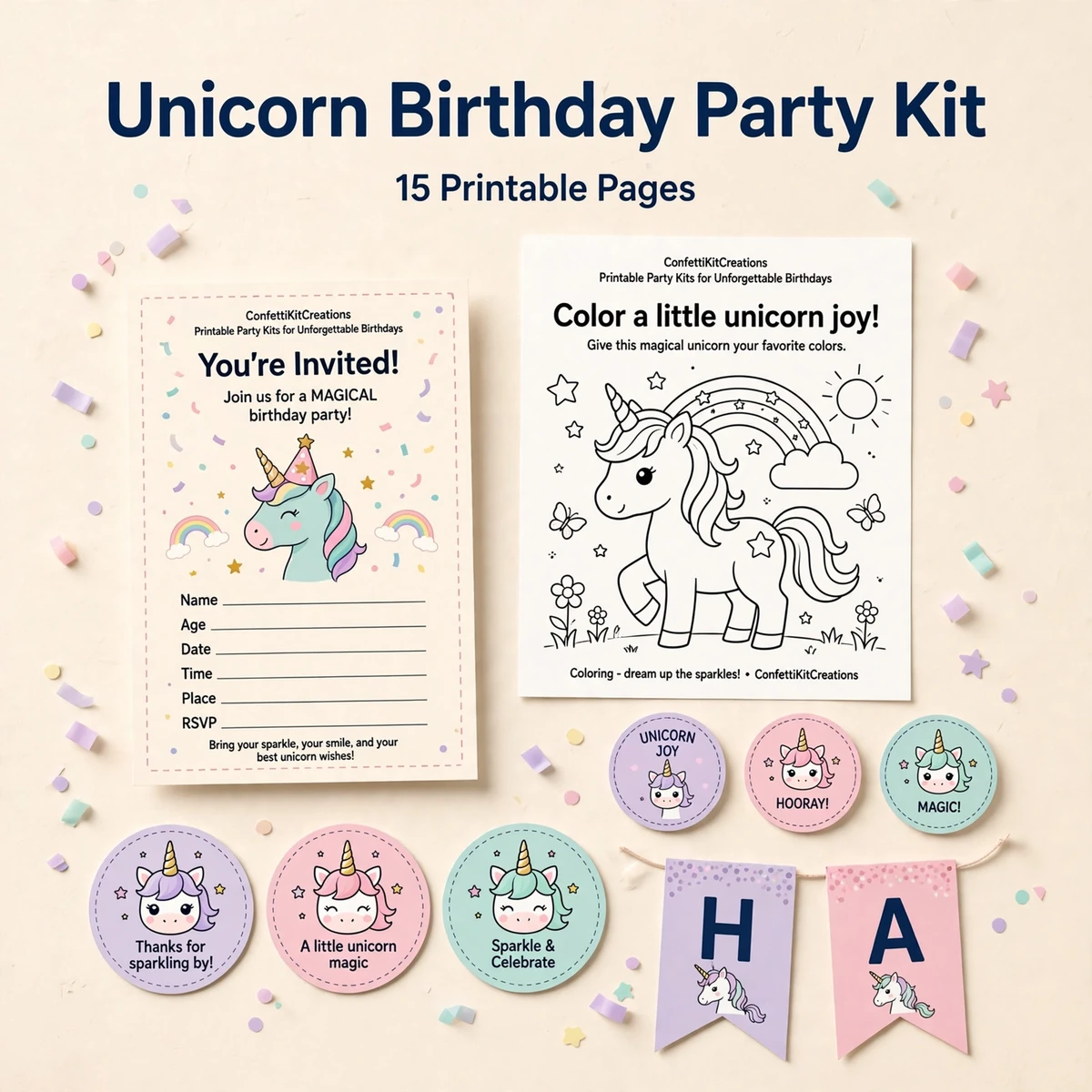
If your child chooses a unicorn theme, our Unicorn Birthday Party Kit can add matching printables. It contains 6 PDFs / 15 pages and is a non-personalized digital instant download purchased on Etsy, with no physical shipment. The three games here are separate DIY activities.
- The day before: confirm attendance and support needs, make all 16 prompt cards and the sample picture, and sort paper into the three folders.
- Before arrivals: test the view from every seat, clear walking routes and set out six writing surfaces. Keep spare sheets and later games with the adult.
- Between games: collect the current cards and sheets before opening the next folder. Keep personal drawings in each guest's envelope.
- At pickup: guests return pencils and collect artwork. Adults gather refreshments, count the reusable cards, wipe surfaces and separate paper scraps for disposal.
Questions, answered.
Can we play without a coffee table?
Yes. Guests draw on clipboards or firm lap boards, and the adult holds the prompt cards. Keep refreshments on a separate stable surface.
What changes for four or eight guests?
For four guests, use two drawing pairs; for eight, use four. Prepare four activity sheets per child, plus the adult sample, two card sheets and three spares. Only invite eight if everyone has a comfortable seat and clear access.
What if the children want to compete?
Give the whole group a shared target, such as identifying six actions together. For drawing, celebrate a direction that helped; for the story, try linking every fix. Keep every guest involved through the last turn.