
THANKSGIVING HISTORY
How Thanksgiving Became a National Holiday: A Short History
Why does Thanksgiving land on the fourth Thursday in November? The answer involves a presidential proclamation, a magazine editor’s campaign, the Civil War and a disagreement about the shopping season. We followed five documents and archival resources to trace how a national observance became a holiday with a predictable place on the calendar. It is a useful story to share when someone asks who decided the date.
Curious hosts and families · Five documents behind the holiday
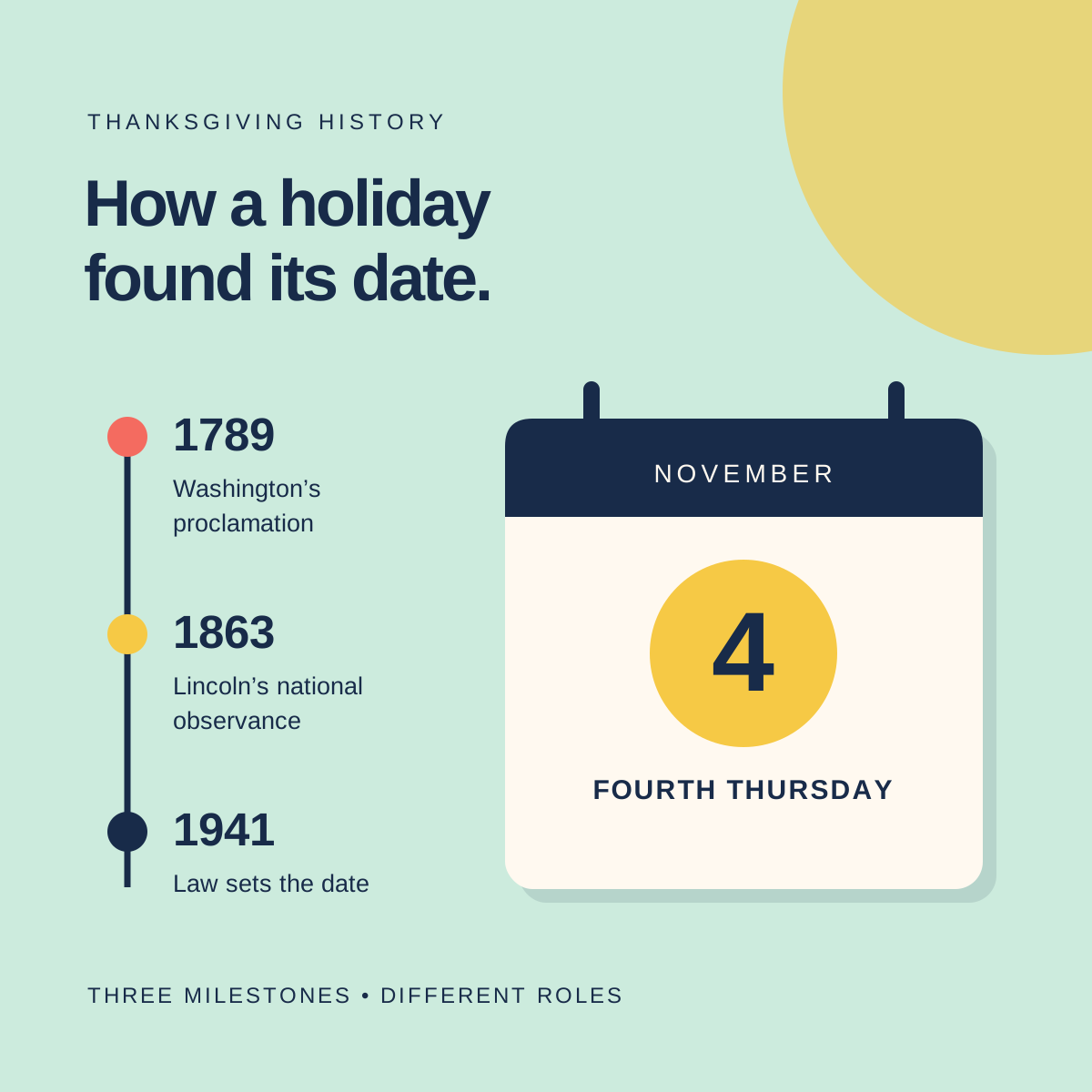
1789: Washington recommends a national day of thanks
On October 3, 1789, George Washington issued a proclamation recommending Thursday, November 26 as a day of thanksgiving and prayer. His text refers to a request from both houses of Congress. It gives thanks for, among other things, the establishment of government under the new national Constitution. [1]
Read the document closely and its scope becomes clear: Washington was naming a particular day that year. He was not writing a permanent rule that every future Thanksgiving would fall on November 26. The proclamation also makes the religious character of that observance explicit, something a modern calendar entry alone does not show. [1]
1863: Sarah Josepha Hale asks for a shared date
In a letter dated September 28, 1863, editor Sarah Josepha Hale asked Abraham Lincoln to give Thanksgiving national recognition and a common date. The Library of Congress preserves the letter and a transcription. Hale said she had promoted the idea in the Lady’s Book for fifteen years and had written to governors and other officials. [2]
Her proposal was specific: a presidential proclamation could encourage the states to observe the last Thursday in November together. The letter is evidence of sustained advocacy, not proof that one person invented every part of Thanksgiving. It lets us see a practical problem—different observances—and one writer’s argument for coordinating them. [2]
1863: Lincoln’s proclamation comes during the Civil War
On October 3, 1863, Lincoln invited Americans to observe the last Thursday of the coming November as a day of thanksgiving. The proclamation, reproduced by the National Archives, combines gratitude with an acknowledgment of the ongoing Civil War. It asks people to remember those bereaved or suffering and expresses a hope for peace. [3]
That context gives the document more weight than a simple announcement of a feast. It addresses a divided country and the consequences of war. The National Archives notes that subsequent presidents continued issuing annual Thanksgiving proclamations. This became an enduring national practice, while the later statutory rule for the date was still to come. [3]
1939: Moving the date creates a disagreement
November had five Thursdays in 1939, with the last falling on November 30. Franklin D. Roosevelt moved the observance to the preceding Thursday, hoping a longer Christmas shopping season would help the economy. The National Archives explains that states did not all follow the change, leaving different parts of the country observing Thanksgiving on different dates. [4]
This episode explains why the words fourth Thursday matter. In a November with five Thursdays, the fourth and the last are a week apart. A date that looked like a small calendar adjustment could therefore disrupt a shared custom. [4]
1941: Congress fixes the fourth Thursday
Congress addressed the disagreement in 1941. The House initially supported the last Thursday, but the Senate amended the resolution to specify the fourth. Roosevelt signed the agreed measure on December 26, 1941. The National Archives presents the legislative documents showing that change. [4]
The enacted resolution, available through the U.S. Government Publishing Office, designates the fourth Thursday of November in each year after 1941 as Thanksgiving Day and makes it a legal public holiday. That wording distinguishes the permanent rule from the earlier annual proclamations. [5]
On any November calendar, count the Thursdays from the start of the month: the fourth must fall between the 22nd and the 28th. A fifth Thursday, when there is one, does not move the holiday. This is a simple calendar consequence of the rule, rather than another historical milestone. [5]
Turn the timeline into a short conversation
We suggest choosing one document to read rather than asking everyone to memorize dates. Notice what its author was trying to accomplish and how that differs from the next document. A recommendation, an appeal to a president and a law are different kinds of sources; looking at their purposes makes the timeline easier to understand.
- Read a paragraph of Washington’s proclamation and notice the reasons it gives for observing that particular day.
- Look at Hale’s letter. What action did she want Lincoln to take, and why did she think it would help?
- Draw a November with five Thursdays. Compare the fourth with the last, then discuss why a shared date might matter to families.
Questions, answered.
Did Lincoln set today’s fourth-Thursday rule?
Lincoln’s 1863 proclamation called for the last Thursday of November. The permanent fourth-Thursday rule came through the congressional resolution signed in 1941, applying to years after 1941. These were separate steps. [3, 5]
Is Thanksgiving always the last Thursday of November?
No. Under the fourth-Thursday rule, it is the last Thursday only when November has four Thursdays. If the month has five, Thanksgiving is the next-to-last Thursday. [5]
Did Washington make November 26 the permanent date?
No. His 1789 proclamation recommended November 26 for that year’s observance. Its text does not establish a recurring November 26 holiday. [1]
Sources for this guide
- [1] Founders Online, National Archives — Washington’s Thanksgiving Proclamation, October 3, 1789 ↗
- [2] Library of Congress — Sarah J. Hale to Abraham Lincoln, September 28, 1863 (PDF transcription) ↗
- [3] National Archives — Lincoln’s Thanksgiving Day Proclamation, October 3, 1863 ↗
- [4] National Archives — Congress Establishes Thanksgiving ↗
- [5] U.S. Government Publishing Office — December 26, 1941 joint resolution, chapter 631 (PDF) ↗