
BIRTHDAY ACTIVITIES
DIY Board Game Birthday Party for Ages 8–12
For a board game birthday party, let guests make the games: create two paper adventures, test the rules, then swap boards to play. We suggest this two-hour plan for eight children ages 8–12, including the birthday child. We provide the starting rules; guests invent the worlds and choices along the way.
Children ages 8–12, with adaptations for younger siblings
Gather supplies for two teams of four
Use two ends of a table, with four reachable seats per board. An adult leads the workshop and helps settle rule questions. Tell guests that each team will make one shared game; individual idea drawings can go home with their artists.
- Paper: 22 Letter or A4 sheets—4 for two boards, 3 for cards, 2 for rule sheets, 8 for individual idea drawings, 1 for playing pieces and 4 spares.
- Tools: 8 pencils, 2 erasers, 2 rulers, 2 shared sets of coloring supplies, 1 roll of tape and adult-use scissors.
- Organization: 2 trays for games, 2 envelopes for cards and 1 container for scraps. No dice, counters or printer are required.
- Refreshments: 8 cups, 8 plates and 16 napkins, plus water, food and cake chosen after checking guests’ food needs. Count attending adults separately.
Prepare the boards and copy the starting rules
Before the party, tape two sheets side by side for each board. Draw START and a continuous path of 12 large numbered spaces; space 12 is FINISH. Outline spaces 4, 8 and 12 boldly and label them CHECKPOINT. Keep the numbers visible when decorating.
Cut the three card sheets into eight equal rectangles each. Give each team 12 cards: six movement cards labeled 1, 1, 2, 2, 3, 3; three checkpoint cards labeled 4, 8 and 12; and three blanks. Cut two 1-inch paper squares from the playing-piece sheet, one shared marker per board. Copy these rules onto each rule sheet:
- Place the shared marker on START. Shuffle the six movement cards face down. Set the checkpoint cards face up beside the board.
- Take turns clockwise. Draw one movement card and move that many spaces, then discard the card face up. START is before space 1.
- Always stop at the next checkpoint, even if the movement card would carry you beyond it. Any unused movement is lost.
- At a checkpoint, the current player chooses and answers one of that card’s two prompts. Draw on individual idea sheets. Speaking, drawing, directing a helper or passing all count. Continue from that checkpoint next turn.
- Shuffle the movement discards when the draw pile runs out. After answering or passing the prompt at space 12, everyone finishes together.
Invent an adventure and three choice cards
Give each guest a sheet to sketch an idea, then choose a setting together: an underwater bakery, a dinosaur picnic or a birthday on another planet. Share drawing, lettering, card writing and checking jobs; swap jobs halfway through. Finish the cards before adding decorative details.
Each checkpoint needs two short choices. Keep answers open-ended, with no wrong answer or movement penalty. These ready-to-use examples can start either game; teams may replace them with their own:
- Checkpoint 4: Name a snack for the journey, or draw the box it travels in.
- Checkpoint 8: Invent a vehicle to carry everyone, or describe one surprising feature it has.
- Checkpoint 12: Name the party destination, or draw its welcome sign.
- Keep new prompts to one sentence each. Avoid personal secrets, quizzes and instructions that send players backward or make them miss a turn.
Test once, fix one problem, then swap
Play one complete practice game using the written rules. Check whether the marker fits, the path is clear and everyone understands where to stop. When something causes confusion, mark it with a pencil and agree on a correction before restarting. Change the wording or layout first; keep the movement rules intact.
Swap the complete trays: board, marker, rule sheet, six movement cards and three checkpoint cards. The visiting team should try following the written instructions before asking the designers for help. Return each game afterward and share one detail you enjoyed and one question the rules could answer more clearly.
- Ages 8–9: add matching dots to the movement-card numerals, read choices aloud and offer the example prompts. Guests can dictate new card text to the adult.
- Ages 10–12: invite guests to invent all six prompt choices and edit their rule sheet so another team can use it independently.
- Younger siblings: offer a counting partner and picture choices. Anyone can point, dictate, move the marker through a helper or take a drawing break; older guests remain players.
Follow this two-hour party timeline
These blocks include explanations and transitions. If decorating runs long, use the example checkpoint prompts and protect the testing time. A readable game is ready to play even with an undecorated corner.
- 0–10 minutes: arrivals, water and individual idea drawings.
- 10–20 minutes: form teams and demonstrate a turn that stops at a checkpoint.
- 20–45 minutes: choose settings, decorate boards and complete checkpoint cards.
- 45–60 minutes: playtest each game and correct one confusing detail.
- 60–75 minutes: put trays aside for food and a bathroom break.
- 75–95 minutes: swap games, play and exchange feedback. Replay if time allows.
- 95–110 minutes: birthday cake and relaxed conversation.
- 110–120 minutes: pack games, collect drawings and welcome caregivers.
Prepare ahead and pack the games together
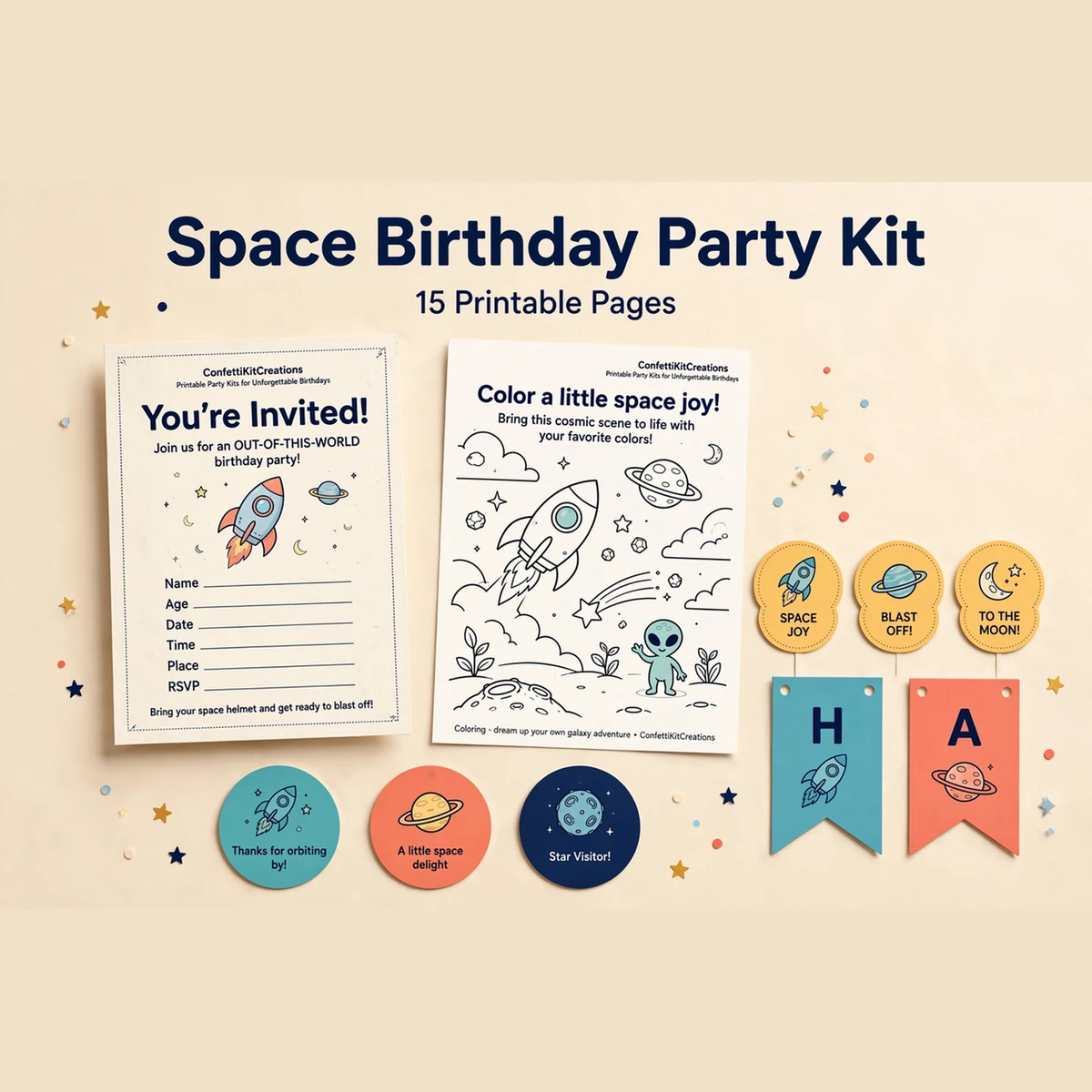
For a birthday-on-another-planet setting, our Space Birthday Party Kit is an optional matching theme. It contains 6 PDFs / 15 pages and is a non-personalized digital instant download, purchased through Etsy or Payhip. Checkout happens in those external stores, and nothing physical ships. The homemade boards, cards and rules here are separate DIY activities.
- The day before: confirm attendance, food needs and helpful adaptations; cut the cards and markers, prepare paths and copy both rule sheets.
- Rehearse a turn: from space 3, a movement card showing 3 stops at checkpoint 4. The two unused moves disappear; the next turn starts at 4.
- Before arrivals: put scissors away, sort team trays and agree where the two shared games will stay after the party.
- At cleanup: put each game’s nine playing cards and three blanks in its envelope. Keep its marker and rules with the board, return tools and collect scraps.
- At pickup: send individual drawings home. Keep shared games with their agreed owner; choose that arrangement before making begins.
Questions, answered.
Can we do this without a printer or dice?
Yes. Handwrite the paths, rules and cards on ordinary paper. The shuffled 1, 2 and 3 movement cards replace dice, and each board uses one paper marker.
How do we adapt the plan for four or twelve guests?
For four guests, make one game and ask an adult to try its instructions. For twelve, prepare three complete team sets and rotate games once. Each extra team needs two board sheets, 12 cards, one rule sheet, one marker and four idea sheets.
Does every child take home a finished game?
This plan makes two shared games, plus individual idea drawings. Agree beforehand who keeps each board. If everyone wants their own game, choose a separate individual-making session with more materials and time.