
CHRISTMAS PARTY GAMES
Christmas Secret Mission Game: A Host’s Plan for Eight Adults
Someone casually mentions a tiny sleigh. Someone else wants help naming an imaginary snowman. At a secret-mission party, those small conversational detours might be part of the game. Give each willing guest one private task, let the party continue and reveal the assignments at the end. This guide includes a complete homemade version for eight adults, plus practical preparation tips if you prefer our Mistletoe Missions printable game.
Eight adult players, including the host · A one-hour game window
Choose a game window that fits the gathering
Run secret missions while guests are already chatting, rather than stopping dinner or a speech to complete them. Tell everyone that a lighthearted game will happen and explain how long it lasts. The assignment is secret; the fact that people are playing is not. Guests who prefer to watch are welcome to stay in ordinary conversation.
For this homemade version, the host is one of eight players and does not need to monitor every exchange. Each task involves something the player can say or suggest, with no need to touch another person's belongings, make someone eat or drink, or ask about private plans. If another guest declines a question, accept that and move on.
Use this guide's rules for the homemade prompts below. If you choose the paid Mistletoe Missions download instead, follow its own how-to-play guide, including its difficulty choices, CAUGHT! cards and scoring. The two versions are alternatives, not instructions to combine several rule systems during the party.
- Set aside one hour that includes setup, two short rounds and reveals.
- Explain that players may swap an unsuitable task or stop playing without giving a reason.
- Choose a host who can announce the start and finish without taking over every conversation.
- Keep a quiet conversation area available, and make every task possible while seated.
Prepare twelve slips and one host sheet
Use four sheets of plain paper. Cut three into quarters for twelve task slips, then keep the fourth whole for the rules, timing and an optional score record. Write the eight main missions on eight slips and the four easier alternatives on the remaining slips. Fold them so the wording is hidden, keeping the alternatives in a separate envelope.
Set out two pens and a bowl for the eight main slips. You do not need eight envelopes, a printer or a prize for every round. Before guests arrive, read each prompt and check that it can be completed in the space you have, without equipment or an unwilling audience.
- Four paper sheets: three for twelve quarter-sheet slips and one for the host record.
- Two pens, a bowl, an envelope for spare tasks and a clock or timer.
- Scissors used during preparation; all cards are ready before the game starts.
- A simple optional score record with eight names and two round columns. Each player's maximum score is two.
Write these eight homemade mission prompts
Put one prompt on each of the eight main slips. A conversational mention counts only when it is spoken to another person during the announced round; reading the card aloud or announcing that you are completing a mission does not count. A question-based task is complete when it is kindly asked in conversation, even if the other guest chooses not to answer.
These are original free prompts for this article, not quotations or sample cards from the paid download. Their small scale is deliberate. The task should give a conversation a playful turn without requiring a guest to stage a performance.
- Work the words snow globe into an ordinary sentence without explaining your assignment.
- Ask someone what they would name an imaginary winter bakery.
- Suggest a cheerful title for a made-up holiday film and briefly describe its story.
- Use the phrase tiny sleigh in a conversational sentence.
- Ask a willing guest whether they would choose tea, cocoa or something else for an imaginary snowy afternoon.
- Ask someone to choose between a make-believe treehouse party and a make-believe lighthouse party.
- Suggest a name for an imaginary friendly snowman and explain one thing it likes doing.
- Ask someone whether a fictional penguin should wear a striped scarf or a polka-dot scarf.
Explain completion, swaps and the reveal
Invite each player to draw one folded main slip. Allow a quiet reading moment before starting the first 20-minute round. A player who wants a different task can choose from the spare envelope. Put the returned task aside for the rest of that round; nobody needs to explain why it did not suit them.
Use these four spare tasks, one per slip: mention an imaginary golden mitten; suggest a name for a fictional winter cafe; describe a make-believe snowflake-shaped cake; or ask whether an imaginary sled should be mint green or coral. They use the same conversational completion rules as the main cards. If the spare slips run out, the host can cross out a returned task and write an easy alternative on its reverse; repeated assignments are fine.
When a player completes their task, they keep the card folded and return to normal conversation. In this homemade version, guessing someone else's mission does not cancel it, and there is no catching or stealing mechanic. Save the guesses for the reveal. This keeps a room of friends from turning into a room of constant accusations.
At the end, stop new attempts and invite each willing player to read their assignment and say whether they completed it. The group can make one friendly guess before a reveal if the player wants. Use honest self-reporting; no photos, recordings or witnesses are required. Count one optional point for a completed mission, or simply enjoy the stories without a score.
For the second round, collect the main slips, return swapped cards to the main pile and put spare slips back in their envelope. Shuffle and deal again. If someone draws the same task they just had, let them exchange it. Everyone now knows the possible tasks, but each person's new assignment is still private.
- One task per player per round; finishing early does not earn another card.
- A guess from another guest has no effect on this homemade game's score.
- Players can pass, swap or leave the game; none of those choices earns a penalty.
- If you keep points, completed missions earn one each, with a maximum of two across both rounds. Ties remain shared.
Keep the entire activity inside one hour
The game runs alongside conversation, so there is no need to fill every minute with host announcements. Give a brief start signal and a clear finish signal. If food is ready, stop the round early and move to the meal; you can still reveal completed and uncompleted tasks together.
For a shorter gathering, use the first round and its reveal as a complete activity. A second round is an option, not a promise the host has to fulfill when the room would rather do something else.
- 0–10 minutes: explain the rules, offer the option to watch, deal eight slips and allow swaps.
- 10–30 minutes: the first mission window, with ordinary conversation continuing.
- 30–40 minutes: optional reveals, a brief reset and new assignments for willing players.
- 40–55 minutes: a shorter second mission window.
- 55–60 minutes: final reveals, shared congratulations and collection of reusable cards.
Prepare a printable version without guessing its rules
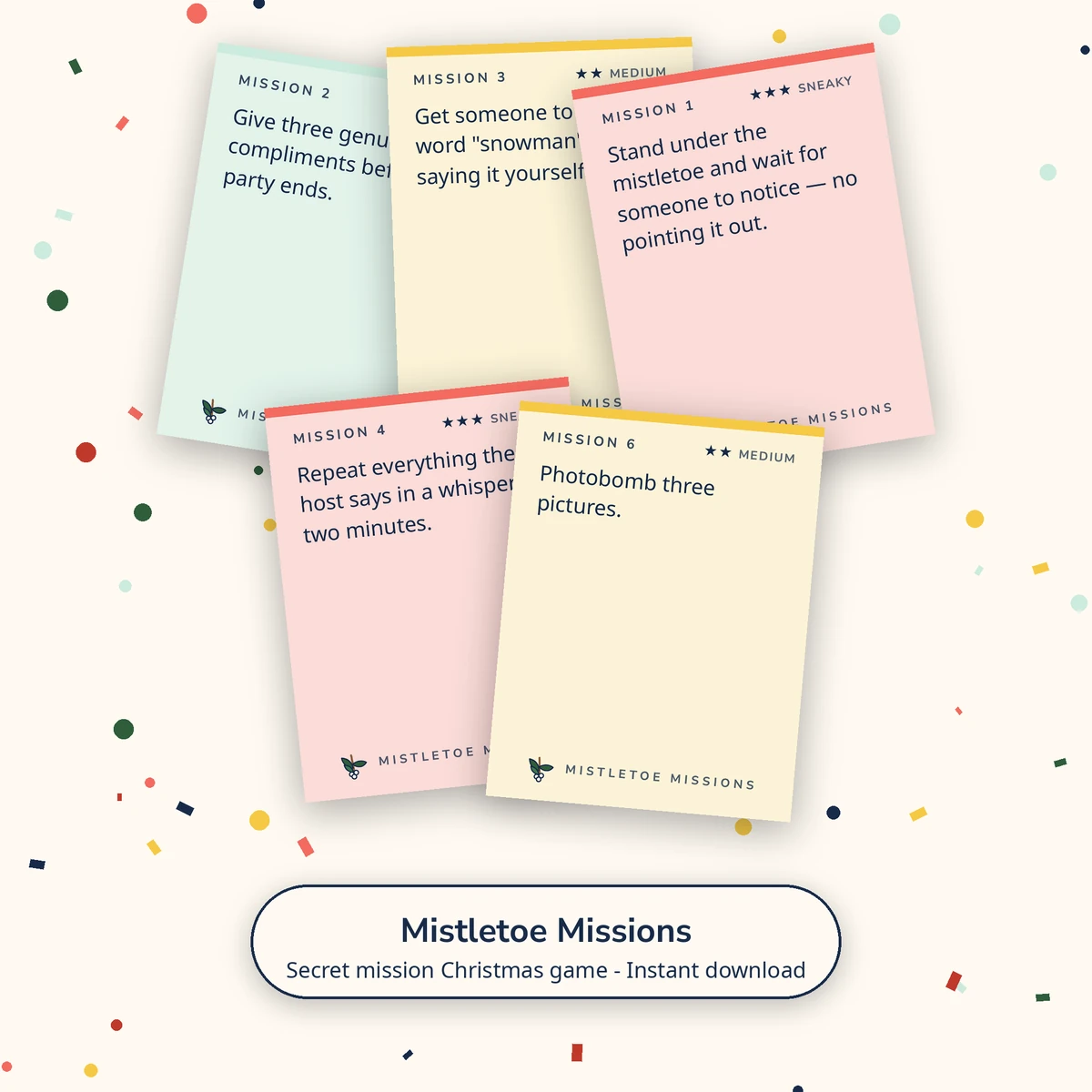
Our optional Mistletoe Missions download includes 48 missions across three difficulty levels, six CAUGHT! cards and a how-to-play guide in two PDFs. The product preview shows nine mission cards per page. Check the current listing and read the included guide to choose a format and difficulty that fit your gathering. No physical cards are shipped.
Print one test page at Actual size or 100%, check the text and cut lines, and then print the pages you need. Select tasks by reading the actual cards rather than assuming a page contains the exact mix you want. Keep the guide with the host and prepare its other components as directed. The homemade prompts above do not describe what individual paid cards say.
After the gathering, collect reusable cards in a labeled envelope with their own rules. Keep homemade and purchased sets separate so the next host can immediately tell which instructions apply. There is no need to retain a score sheet once the group has finished celebrating.
Questions, answered.
Do players have to trick other guests into doing something?
Not in this homemade version. Each mission asks the player to say, suggest or ask something in conversation. Another guest can decline to answer, and no task requires touching belongings, physical contact, eating, drinking or sharing personal information.
Can guests who arrive late join the game?
Yes. Give a willing late arrival an unused spare task and explain the current round's finish time. Do not extend the whole round or promise equal scoring time; you can skip points altogether when people come and go.
Can we use this for four or twelve players?
For four, deal four of the eight main slips and retain the others for a second round. For twelve, add four more main tasks and keep four spares, using sixteen slips from four sheets plus one host sheet. Keep reveals brief or split them into smaller groups.