
OFFICE CHRISTMAS PARTY GAMES
Christmas Office Party Games: A 45-Minute Plan Without the Awkwardness
The best office party game gives colleagues something funny to talk about without turning anyone into the entertainment. Try three short table activities: vote on an imaginary festive dilemma, build a paper present and invent the world's least useful holiday gadget. This 45-minute plan is written for twelve people in three teams. It needs no personal trivia, performances, gift purchases or knowledge of Christmas films. For a ready-to-print alternative, our Office Christmas Party Games Pack includes people bingo, secret missions and a host guide.
Twelve colleagues · Three teams of four · 45 minutes
Make the invitation clear and participation optional
Tell colleagues what the activity block involves, how long it lasts and that watching is welcome. A manager should not have to persuade someone to join. Seat people where they can take part comfortably, and offer a quiet conversation space for anyone who would rather skip the games.
Choose the event's language with your team. If a winter or end-of-year theme fits better than Christmas, change the labels and use the same mechanics. The prompts below do not rely on religious knowledge or shared holiday traditions. Nobody needs to explain why they are participating, watching or leaving.
Choose one host and keep the competition light. Teams can give themselves imaginary names, but avoid department rankings or jokes about real colleagues. Give equal recognition to every team instead of treating the party as a test of who is outgoing, creative or quick.
- Make all three activities seated, with tools and paper within reach.
- Offer drawing, writing, suggesting ideas and reading as interchangeable roles.
- Keep cameras and recording out of the games unless people have freely agreed.
- Write the finish time where the host can see it and return to the social gathering on schedule.
Pack one envelope and three team trays
Start with 23 sheets of ordinary paper. Cut six in half for twelve two-sided voting cards. Each team then gets four full sheets for the present-building challenge, using twelve more. Set aside three sheets for the gadget activity and two for the host's prompt list and notes. That is six plus twelve plus three plus two: 23 sheets.
On each voting card, write A on one side and B on the other. Prepare three equal 24-inch lengths of removable paper tape for the building round, each parked on a smooth reusable surface. This gives every team the same materials without a shared tape roll becoming the main attraction. Test that your tape peels away cleanly before the party.
- Twenty-three paper sheets, twelve pens and three team trays or cleared spaces.
- Three 24-inch tape lengths, totaling 72 inches, prepared before play.
- One ruler for the host, a timer and a spare pencil for the building demonstration.
- Scissors for advance preparation only; the challenge itself uses folding and tearing.
- A container for paper scraps and a place to return reusable supplies.
Game 1: vote on a festive dilemma
Give everyone an A/B card and read one imaginary dilemma at a time. Allow a brief discussion at each table, then count down from three so willing guests show their choices together. A raised hand can replace a card, and a guest may abstain. Invite one short explanation for each choice without asking people to defend it.
There is no correct answer and no winning side. Keep the examples fictional rather than letting them become commentary about a real office disagreement. If a prompt feels too close to an actual situation, use the next one. Three rounds are enough for a ten-minute opener.
- A fictional team gets one wildly impractical decoration: A, a ceiling full of paper snowflakes, or B, a desk-sized cardboard castle?
- An imaginary wrapping machine has a flaw: A, it sings while wrapping perfectly, or B, it wraps silently but every parcel looks like a carrot?
- A make-believe winter cafe can serve only one unusual special: A, square marshmallows, or B, star-shaped toast?
- Optional spare: a pretend party invitation arrives from A, a snowman orchestra, or B, a penguin book club. Which would you visit?
Game 2: build a paper present with a secret compartment
Give each team its four sheets and one prepared tape length. Their task is to make a freestanding paper present with a small compartment that can hide the host's spare pencil. The pencil must go in and come back out without tearing the structure. Show its size first; teams use their own pens as stand-ins while designing.
Allow seven minutes to fold, roll or tear the paper and assemble the design. The present can be a bag, a box, a tower with a flap or something that has never existed before. One person can sketch, another can fold and another can suggest how the compartment opens. Nobody has to build by hand to contribute.
For the demonstration, each team has one minute to place the present on the table, put the pencil inside, let go for five seconds and retrieve it. If it collapses, let the team explain what they would change. Celebrate an inventive feature from each design instead of ranking the teams. Leave heavy objects out of the test.
- Keep the same paper quantity, tape length and test pencil for all teams.
- A team may sketch its mechanism and explain it if making a model does not suit its members.
- Do not turn this into a height contest; the useful challenge is an opening that works.
Game 3: advertise a wonderfully useless gadget
Give each team one fresh sheet and the same brief: invent a holiday gadget with a cheerful name, three unnecessary features and a one-sentence advertisement. Examples to start the discussion include a ribbon straightener for already-straight ribbon or a machine that counts the empty spaces in a biscuit tin. Teams should create their own version rather than copy the examples.
Give them four minutes to draw or describe it. Each team then has up to one minute to share, with the host available to read the advertisement. No sales performance, acting voice or public pitch is required. The joke belongs to the imaginary product, never to an employee, client or customer.
If the room is enjoying the activity, let teams ask one fictional customer question, such as whether the gadget comes in polka dots. Finish after the final response. People can take their drawings, leave them on the table by agreement or recycle them.
Keep the schedule short and choose printables deliberately
This plan fills one 45-minute block including instructions and transitions. Keep a visible timer for the host, but do not score people by speed. For a 30-minute slot, play the voting and gadget games, allow a short conversation break and leave out the construction challenge.
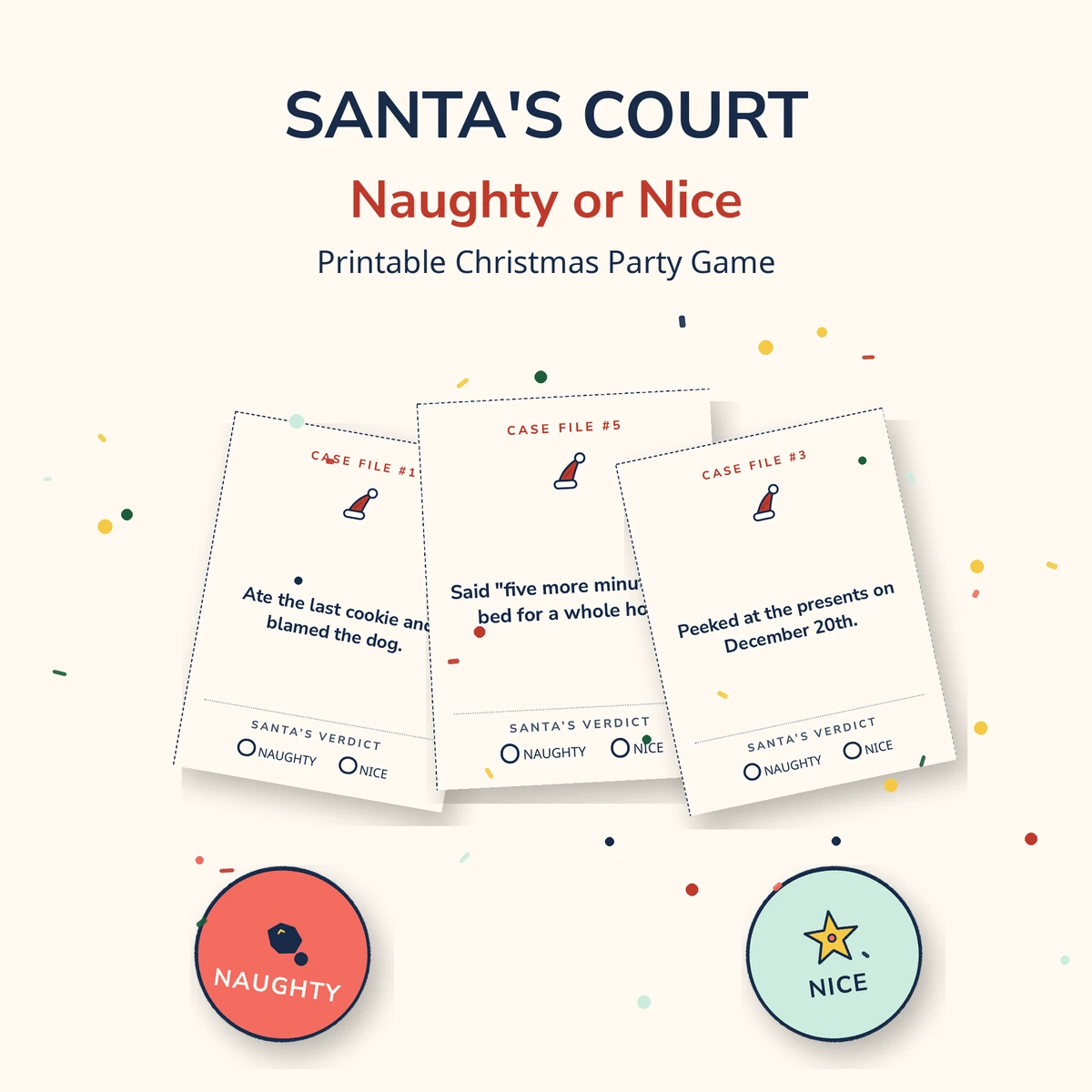
If your group would prefer ready-made festive cases, our optional Santa's Court: Naughty or Nice download offers 60 case cards, voting paddles, judge badges, a score sheet and a how-to-play guide. Review the cases and included instructions before choosing it for your team. Its score sheet has six rounds for up to eight players, so do not assume one sheet covers this guide's twelve-person group; select a suitable group size and format from the product instructions.
The A/B dilemmas, paper-present challenge and gadget activity above are separate homemade games, not descriptions of the paid case cards. Whichever version you choose, prepare the materials before the event, explain that passing is welcome and stop while there is still time for unstructured conversation.
- 0–5 minutes: welcome, form the three groups and explain the available roles.
- 5–15 minutes: three festive-dilemma votes and brief discussion.
- 15–30 minutes: explain the paper-present challenge, build, demonstrate and clear the scraps.
- 30–40 minutes: invent the useless gadgets and share the advertisements.
- 40–45 minutes: thank each group, return supplies and close the organized activities.
Questions, answered.
How can we include colleagues who dislike party games?
Make the activity block optional and describe it in advance. Watching, suggesting an idea or reading for a teammate can all be welcome, but none should be required. Leave room for ordinary conversation elsewhere.
Can we use a winter theme instead of Christmas?
Yes. The voting prompts already use imaginary settings, and the present can become a paper parcel. Rename the gadget a winter invention and use the same timings. Ask your team which framing suits the gathering.
How do we adapt this for twenty colleagues?
Use five teams of four. Prepare ten sheets for twenty half-sheet voting cards, twenty building sheets, five gadget sheets and two host sheets: 37 sheets total. Give each team the same 24-inch tape length and shorten presentations to keep the block near 45 minutes.